
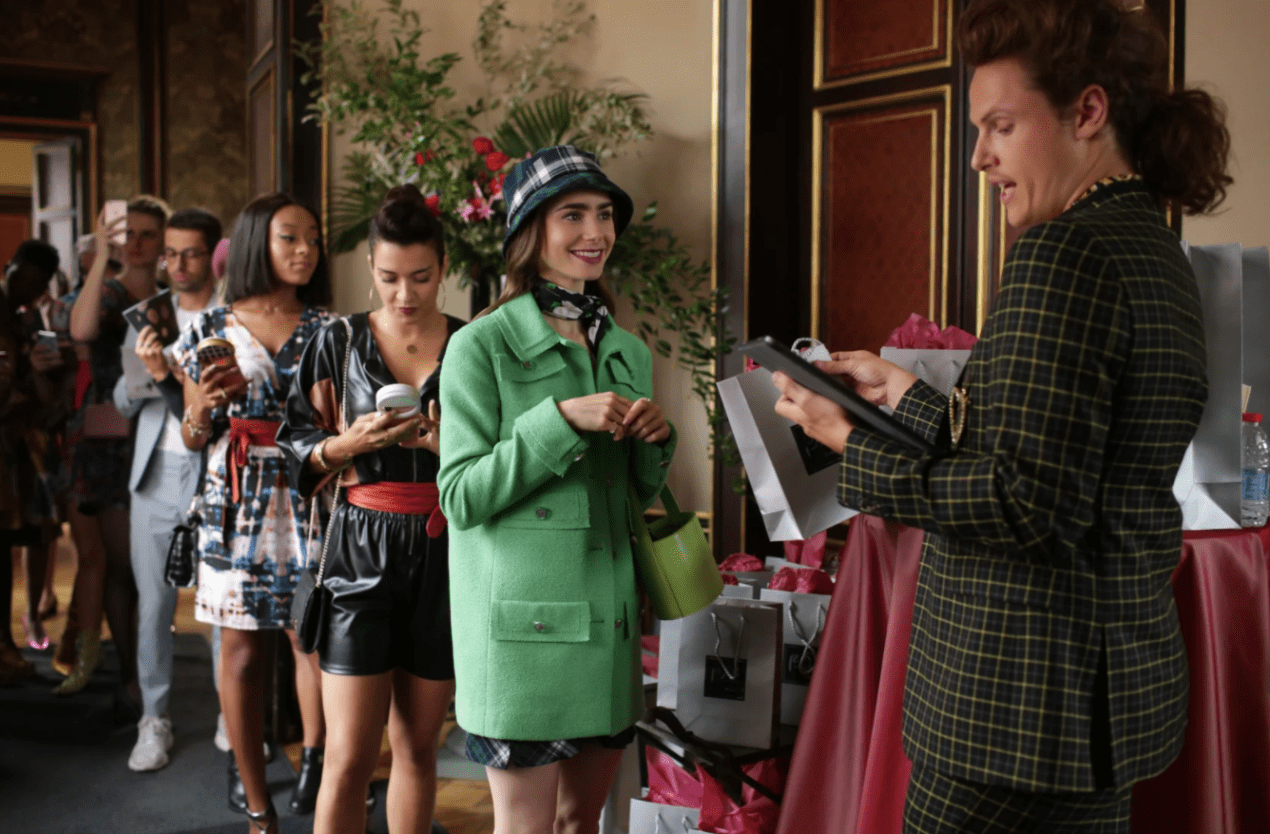
I think it’s fair to say that 95% of the internet agrees that Emily Cooper’s wardrobe is a complete mess. From rainbow colored-pencil skirts to frilly-tiered dresses, there’s lots to unpack with E.C’s closet. Honestly, I can’t bring myself to hate her aesthetic. Some outfits definitely work—but I can imagine some casual dressers gasping and oogling at a few controversial fits. Emily Cooper is into fashion, but you knew that already. From season one to two, her ensembles cater to the maximalist aesthetic. She’s big on bold colors, patterns, and silhouettes—as it’s pretty rare to catch her wearing something downtoned and subtle.
While others define Emily’s style as digital vomit, I think it’s a fairly smart wardrobe choice—given her personality and living situation. We often forget that the ‘American girl lost in Paris’ is a TV trope done to death. From Anna and the French Kiss to Sex in the City, audiences continuously wipe their memories of this tired cliche to clap and laugh again at quirky Americanism. To western viewers, the protagonist features a commercial woman with ‘Bambi’ eyes as she learns the intricacies of Parisian culture. To a local, it’s definitely something worth rolling your eyes over. Fortunately, today’s society realizes that there’s really no need to recycle this trope again. If anything, ‘alien-ness’ is more so attributed to the westerner than the location itself. Emily Cooper is the outsider looking in, and her naivety isn’t supposed to be cute. Instead, it can be accurately translated into cultural ignorance.
Fashion plays an important role in addressing Emily’s Cooper character. Her wild silhouettes and love of colors can signify her outsider status. She does her best to understand Parisian culture, and it shows through her ‘try-hard’ efforts through outfit coordination. By no means am I saying that maximalism is the ‘copycat’ at fashion, but instead—I’m referring to the show’s take on style as a character definer. As a viewer, I see Emily’s wardrobe less as a statement and more as a ‘cheek-and-tongue’ metaphor. Emily in Paris, to me, is painfully self-aware of its trope, and they’re trying to show us in a more visual manner.
 Sophie's Fashion Blog